
In the summer of 1991, as the giants of Milan, Turin, and Naples counted their trophies, a club from the Ligurian coast ripped up the script. Sampdoria — a team built not on superstars, but on friendship, vision, and sheer defiance — stunned Italy by winning the Scudetto. Led by the fiery genius of Roberto Mancini, the lethal instincts of Gianluca Vialli, and the quiet charisma of manager Vujadin Boškov, they conquered a league at the height of its golden era. But just as quickly as they rose, Sampdoria began to fall. Within a decade, the dream unraveled — a tale of missed chances, lost leaders, and the harsh reality of modern football. This is the story of how a family-built dynasty captured the heart of Italian football… and how it slipped away.
Traditionally, Genoa were always the more decorated club until this point, but in 1979 something happened in the city that would flip this on its head. Temporarily.
Born in Rome just before the Second World War, eventually settling in Genoa in 1955, Paolo Mantovani became a shipping magnate over his lifetime and, although originally a Lazio sympathiser, he became a fan of Sampdoria and would purchase the club he grew to love on July 3rd 1979. Mantovani transformed Sampdoria over his stewardship from a yo-yo club in Serie B into a European and Italian powerhouse – briefly.

Mantovani planned to operate the club completely differently to our previous article’s subject – Parma. His plan was to build Sampdoria up into an irresistible force. He was quoted as saying, “I don’t buy champions, I build them”. The change in Sampdoria was accelerated by the 1986 appointment of Vujadin Boskov. The Serbian manager would bring tactical discipline and strong man management. The Serb employed a straightforward, compact, disciplined 4-4-2 system – with emphasis on wide play and a lethal strike duo,

That duo was already in place at the club when Boskov was appointed, with Roberto Mancini and Gianluca Vialli forming a deadly duo that would last until the summer of 2021 when Vialli was assistant to Mancini as Italy won the European Championships.
Mancini started his career with Bologna before making the move that would make him. He joined Sampdoria in 1982 and through his time there, he would go on to make over 400 appearances and score 130+ goals. He formed a deadly duo with Vialli when he joined in 1984 from Cremonese. Vialli would stay for 8 seasons and contribute over 80 goals in this period.
Those numbers might sound low, but for a club of Sampdoria’s stature, it was immense. The duo, nicknamed The Gemelli del Gol (the Goal Twins), did enough to fire Sampdoria to their first (and only) ever Scudetto. During that 1990/91 season, while it was still 2 points for a win and a 34 game season, Samp scored 57 goals on their way to securing the title, conceding only 24 goals on the way. During this season, they captured key wins like 2-0 away to Inter at the San Siro and 1-0 over Milan at home. The title was clinched on 19th May when they crushed Lecce 3-0.

Mancini and Vialli weren’t the only ones who were making a name for themselves in this team. A young goalkeeper by the name of Gianluca Pagliuca was impressing, on his way to becoming Italy’s number one. Attilio “Popeye” Lombardi was working away tirelessly on the wing and Pietro Vierchowod was a defensive rock known as Lo Zar.
It wasn’t just a Scudetto season for Sampdoria though, they would see European success with a 2-0 victory in the European Cup Winners Cup over Anderlecht in Gothenburg – Samp’s first European trophy. They would have an opportunity to add another to the collection next season.
During the 1991-92 season, Sampdoria would be the sole Italian representative in the European Cup – now the Champions League. Back in this era, only the champions of each nation made it into the cup. Sampdoria would open up with a two legged tie against Norwegian champions Rosenborg. They would be despatched easily with a 5-0 and 2-1 victory, making it 7-1 over the two legs.
Round 2 proved slightly trickier for the Italian champions, scraping through against Kispest Honved of Hungary. Trailing 2-1 from the first leg, they inspired themselves in the return leg into a 3-1 victory, narrowly getting into the Group Stage after a 4-3 aggregate win thanks to two goals from Vialli.
With the competition splitting into two groups of 4 for Round 3, effectively an 8 team Semi Final with the top team in each group making the final, Sampdoria were drawn with Red Star Belgrade, Anderlecht and Panathinaikos. Sampdoria progressed with relative ease, losing only once to Red Star, while winning 3 and drawing 2 matches. They topped the group 2 points ahead of Red Star and the only team in that group with a positive goal difference.
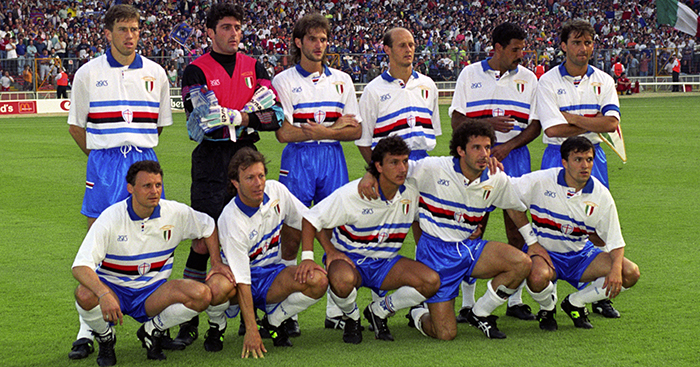
It remains their only European Cup Final appearance to date. The other half of the draw was somewhat trickier, with Dinamo Kiev, Benfica, Sparta Prague and Barcelona competing to face Sampdoria in the final. It probably comes as no surprise that Barcelona would progress from this group and face off against Samp in the final at Wembley Stadium in London.
The final at Wembley Stadium was the last to be held before the European Cup format was abolished and rebranded as the Champions League. Neither team had won the European Cup before so whoever would take away the trophy would become the 19th overall winner of the tournament.
A Sampdoria team featuring Pagliuca, Mancini, Vialli, Bonetti, Lombardo and Vierchowod would face a Barcelona team stacked with names such as Zubizaretta, Koeman, Ferrer, Guardiola, Laudrup and Stoitchkov. The expectation was that Johan Cruyff’s superstars would crush Sampdoria and their constant overpunching. Things in football rarely turn out as expected though and at the end of 90 minutes, the scores were locked at 0-0.
It would take something special to win this game, and unfortunately for Sampdoria it was provided by Ronald Koeman. In the 112th minute, he stepped up to lash in a spectacular and memorable free kick to break Italian hearts. Sampdoria and Mantovani had come so close to fulfilling the impossible dream, they’d got to the final hurdle and stumbled. A lot of eggs were put in this European basket and a 6th place Serie A finish meant the decline had started.
Boskov had declared the European Cup final would be his last hurrah and he’d be moving on. He would briefly return to Sampdoria a few years later, but the magic had gone. Vialli was sold to Juventus that summer for a then World Record €12.5m and the team was weakening. Mancini would remain more loyal and stay until 1997 before moving on to Lazio.
On 14th October 1993, Paolo Mantovani passed away at the age of 63 with lung cancer. Sampdoria mourned. His second child Enrico Mantovani would step into the role of President and vowed to continue his fathers legacy. However, during these years, fortunes at the club began to slip away. It’s hard to compete with the big superpower clubs just once, but to sustain it with a “family atmosphere” and hard work is damned near impossible. Enrico did recognise this and would add Jurgen Klinsmann, Giusseppe Signori and Vincenzo Montella to the ranks. They would win the Coppa Italia – their 4th – in 1994 while finishing third in the league under the enigmatic Sven Goran Eriksson.
However, gradually, the core of the team was sold, Pagliuca went, as did Lombardo and Vierchowod and by 1997 Eriksson had gone to Lazio and taken Mancini with him. The club was gradually losing its identity, the management door was a revolving one and eventually, following a 2-2 draw at Bologna in 1999, Sampdoria were relegated to Serie B for the first time in 17 seasons. After the death of Paolo Mantovani the club appeared to gradually lose its direction, it became harder to compete with the other Northern powerhouse clubs like Juventus, Inter and Milan.

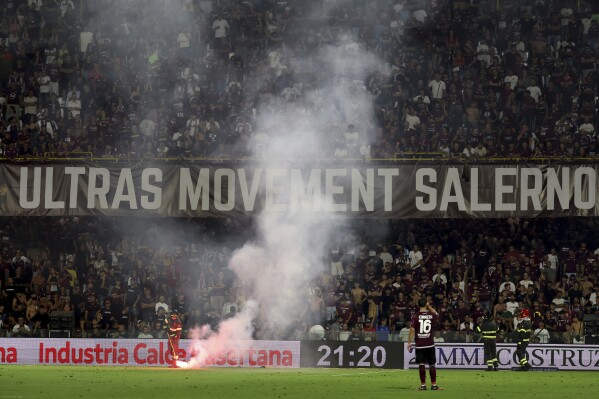
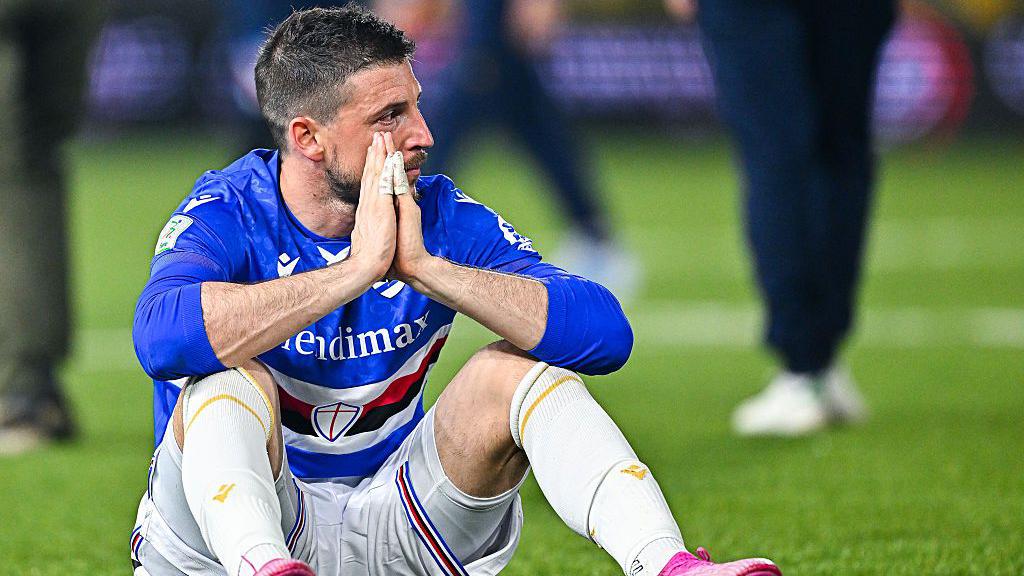
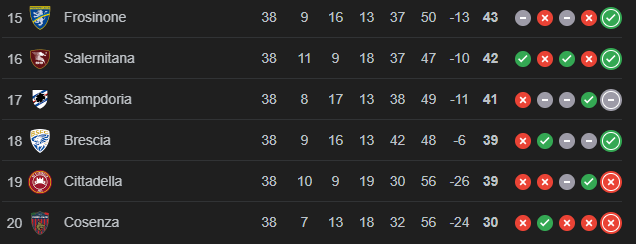
Since then, Sampdoria have spent some time bouncing around between A and B, they did briefly return to Europe in 2010 but this soon collapsed after the sales of Cassano and Pazzini. The club has continued on its downward curve and this season were finally relegated to Serie C, before being given a slight reprieve. Thanks to the difficulties of Brescia, and their subsequent points deduction Samp got a second chance at survival with a relegation play off against Salernitana. They would win the tie, sort of, with the second leg being abandoned with them 4-0 up on aggregate thanks to protesting Salernitana fans. Hopefully this is used as a chance for Sampdoria to kick on and return to their former glory.
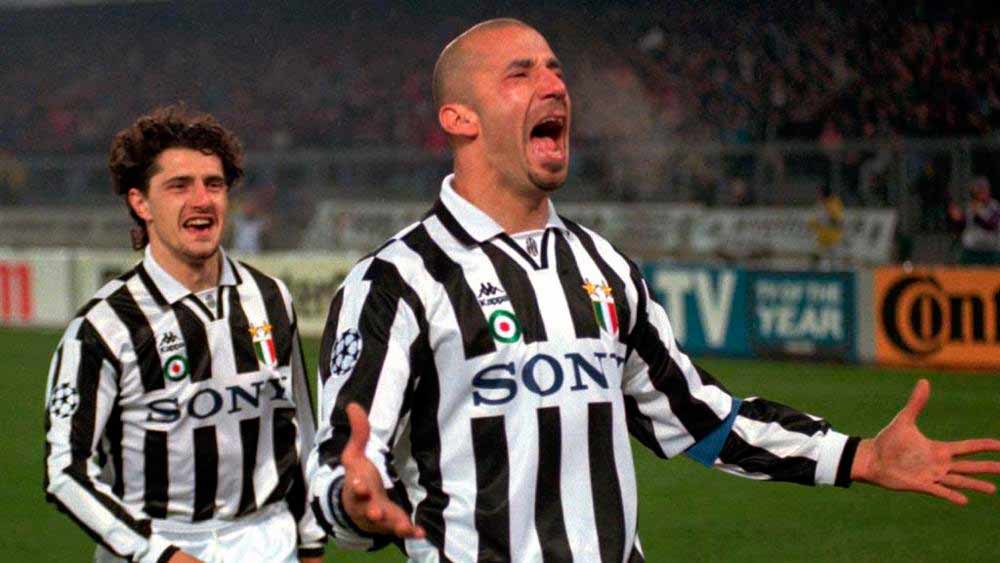
Wherever they are now, it’s hard to argue that Sampdoria’s Scudetto is one of the more romantic ones in Serie A. A true underdog story and a romantic notion that a team could be built rather than bought. Mancini and Vialli’s friendship is legendary in the sport and the Samp way was to mix grit and determination with style and flair, unique for a non-giant. Sampdoria’s fall serves as a cautionary tale of poor succession planning and the dangers of losing the visionaries within the club. But I like to think of their legacy as per Vialli’s words when talking about Sampdoria, “Winning with friends is worth more than winning alone”. And isn’t that what football’s about?



 The Calcio Blog