
We English have a habit of laying claim things that aren’t ours. Like half the World at one point… But one thing we do have a pretty firm claim on is that we invented the beautiful game.
In the 1920s and 30s Benito Mussolini would have Italians believe that Calcio descended from Calcio Storico Fiorentino, the medieval football of Florence. This game was mostly played by noblemen (including Popes) and dates back to 1530 where it was first referenced in Piazza Santa Croce. The game combined elements of football, rugby, wrestling and street fighting, which I guess is where the great Italian defenders of the 70s and 80s were drawing inspritation.
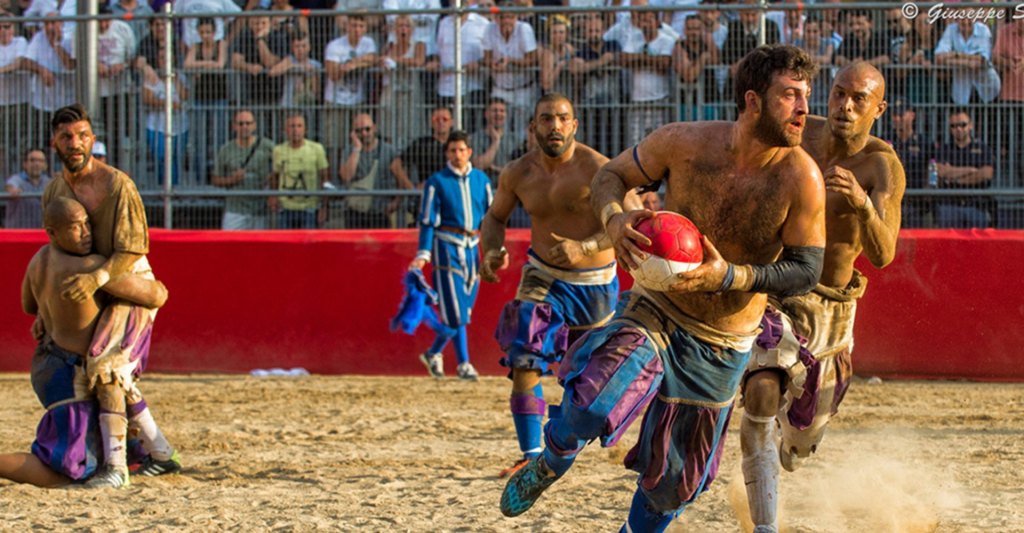
Benito Mussolini promoted the game as the “true origin” of Calcio in direct contrast to the foreign game of football. He used the game in fascist propaganda to reinforce the idea of Italy’s deep cultural and martial heritage, distancing itself from British influence. The game was even revived in the 1930s in Florence with choreographed pageantry to tie it in with Renaissance and Roman virtues.
But Calcio does owe a lot to British football, including one of its biggest clubs and one of the most iconic kits in the game.
James Richardson Spensley in Genoa
Dr James Richardson Spensley was an English physician and football enthusiast who worked on boats that came through the port in Genoa. During his time in Italy, Dr James would organise football matches with local dockers and as a result, is largely considered to be the first person to bring football to the masses in Italy.

By 1897 he had founded the Genoa Cricket and Football Club. Not only did he found the club, but he managed it, organised their games and was their goalkeeper. He helped to shape Genoa into the first dominant team of Italian football, winning the first championship in 1898, going on to win another 5 titles with him at the helm. He retired from playing when he was nearly 40 and would go on to manage the side for a few more years before his death in World War One at the Fortress of Mainz.
Had it not been for the four clubs in Turin founded by Edoardo Bosio then Dr James would’ve founded the first club in Italy. The two of them are rightly considered as the Grandfathers of Italian football.
Herbert Kilpin and the Milan cricket club
129 Mansfield Road in Nottingham is an unassuming terraced property that could be any other in England. However, on the 24th January 1870 at this property, a man was born who would go on to shape Italian – and World – football for years to come.
Herbert Kilpin was a lace maker who lived most of his life in Nottingham playing as a Midfielder and Defender for local part time teams. In 1891, he moved to Turin to work for Edoardo Bosio who was an Italian-Swiss textile merchant. Bosio had founded the first ever Italian side, Internazionale Torino, and Kilpin would represent the team in his time with Bosio.
In 1898, however, while living in Milan with Samuel Richard Davies, Kilpin would found AC Milan, then known as the Milan Cricket and Football Club. To this day Milan still uses the English spelling of the city’s name to pay homage to their founder.
He chose the famous red and black stripes after being quoted as saying, “We’re going to be a team of devils. Our colours will be red like fire and black to invoke fear in our opponents”.

The first elected president of AC Milan was Alfred Edwards with Kilpin acting as player-manager. Milan were, unsurprisingly, immediately successful, winning the championship in 1901 in only their second season. Kilpin spent 9 years with the Milan side and won two more titles in 1906 and 1907.
Herbert Kilpin died in Milan in 1916 aged 46, apparently due to his smoking and drinking habits – another English trait. Little was known, or acknowledged, of his influence over Milan’s early history until the 1990s when Luigi La Rocca tracked down Kilpin’s grave in the Municipal Cemetary in Milan. In 1999 the club paid for a new tombstone acknowledging his role in Milan’s history and in 2010 he was moved into the Famedio in the main building where Milan’s most illustrious personalities are interred.

John Savage and the spare kits
Nottingham’s influence over Calcio doesn’t finish there though, a few years later in 1903 an Englishman John Savage would help one of Italy’s most iconic clubs gain their iconic kit design.
John Savage was a footballer who had played with Kilpin at Internazionale Torino before joining Juventus in 1900. He was the first foreign player to represent the Old Lady, who at the time wore pink shirts. Savage wasn’t impressed with the quality of them though and likened them to being similar to a “gang of war survivors”. Whatever that means.
He wrote a letter to Nottingham based tailoring company Shaw and Shrewsbury requesting new kits and nearly a month later received a spare set of Notts County kits, in the famous black and white stripes.

At first, Juventus were not impressed with the change, Domenico Donna – a founder of Juventus – compared them to funeral attire. However, thanks to a remarkable upturn in form in the new kits, Donna labelled the kits as “a symbol of old fashioned Piedmontese elegance”.
Juventus would keep the Notts County kits and the retain the black and white to this day, the link remained so close that when Juventus opened their new stadium in September 2011, Notts County were invited over to play in the first ever game here.
John Savage would go on to referee the 1902 Italian Football Championship final between the other two English influenced clubs, AC Milan and Genoa.
More general influences
The Italian Football Federation (FIGC) was inspired by the structure of the English FA when it was formed in 1898. Not much of a surprise given the English influence of the game in those early years, rules and club structures were based on the English game and most of the clubs were started as cricket and football clubs.
In fact, one of the Italian terms still used today, Il Mister, used to describe a coach is attributed to an affectionate term given to William Garbutt during his time managing Genoa between 1912-27. He won three championships with Genoa and introduced structured training and tactics to Italian football.
Inter and Roma are two clubs that have had English ownership stakes or partnerships in the past and Serie A was brought into British homes in the 90s thanks to James Richardson and his Sunday show Football Italia on Channel 4. That programme, in fact, was responsible for this Calcio fan’s own obsession!
Much like everything else though, England introduced the sport to Italy but Italy took it and ran with it, made it their own and subsequently has won 4 World Cups to England’s one. They even beat England in their own back yard in the Euro 2020 final after a penalty shootout to really assert their dominance over the English game.
While English domestic football has surpassed Italian domestic football for quality and finances, Calcio had some great days in the 80s and 90s and Italian clubs still have joy against Premier League teams in England.
England and Italy will always be inseparable for their love of the game and their passion for it, and we’ll always be linked thanks to those English pioneers back in the day.


















 The Calcio Blog