In just the past year, Italy has watched a golden generation slip through its fingers. Mateo Retegui headed to Saudi Arabia, Giovanni Leoni swapped Parma for Liverpool, Riccardo Calafiori moved abroad, and Diego Coppolla packed his bags too. They’re part of a growing list of young Italian footballers leaving Serie A in search of opportunity, money, and trust.
It’s a worrying pattern — and one that could shape the future of Italian football for decades.

The Growing Exodus
This summer Italy lost her top scorer to the Saudi Arabian league. Not such a shock that Italian teams can’t keep up with the wages in Saudi Arabia, even the Premier League struggles with that. What was alarming was that Mateo Retegui is 26 years old, and had just won the Capocannoniere (top scorer award).
Then, after Juventus, Inter and Milan were all circling the Parma prodigy Giovanni Leoni, Liverpool swooped out of nowhere and took the centre back to England. The reported fee of €40m shouldn’t really have been too beyond the three biggest clubs in Italy.
As well as this, Calafiori headed to London last summer, Diego Coppolla has chosen Brighton this summer. Some players you’ve probably never heard of that have left Italy include Samuel Pia and Luca Reggianni are both in Germany at Dortmund, Manuel Pisano went over the Alps from Turin to Munich in 2023 and Guido Della Rovere went from Cremonese to Bayern too.
Why Are They Leaving?
It depends on the player, is the shortest answer we can give here… Leoni and Calafiori undoubtedly left because there was more money on the table in England than in Italy. This financial weakness was highlighted by Luigi De Siervo (CEO, Serie A) who blamed rampant illegal streaming for severe revenue losses. He estimates this to be roughly €300m annually, which is affected the wages that Italian clubs can pay, along with stifling investment into youth development and their infrastructure.
But lower down the age groups, why are players leaving Italian Academies for Germany? There’s no real player pathway for Italian footballers to break into the first team in Serie A. Unless you’re a truly exceptional talent, the over reliance on experienced players in Italy means there’s no way to force your way into the team. Therefore, the naturally inkling is to look elsewhere. Germany has a reputation for blooding young players, even the high stakes of the English Premier League give young kids a chance from time to time.
This brings an over reliance to Serie B or Serie C teams, the standard is much lower, the development isn’t as intense and the development window for great talent is missed. Players don’t see any Serie A minutes until the age of 22. Enzo Maresca (Chelsea Manager) even pointed at this reliance on “experience” led to the demolition of Inter Milan in the 2025 Champions League final.
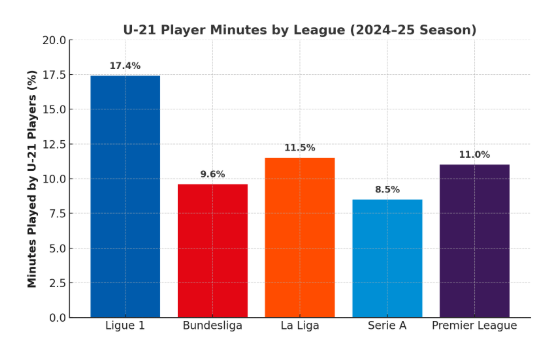
Carlo Nesti (veteran journalist) paints a grim picture of life in Italy for young players. Serie A has a high foreign player ratio of 50-60%, with only about 3-6% of playing time in Serie A going to Under 21 Italian players, far below peers like La Liga and the Premier League. The Italian overemphasis on tactical rigidity and defensive habits along with dwindling grassroots and street football sees a demographic decline in young Italian players making the grade.

The Cost For Italian Football
The cost of the decline in young Italian talent staying in Italy is threefold. There’s the natural risk of a weaker national team, the loss of connection between clubs and their local communities and fans being deprived of seeing their own talent grow at home.
The national team weakness is fairly self explanatory. If your best young players scatter all over Europe, then they’ll grow up in different systems and different philosophies before returning to play together. In theory, the players could flourish under these better foreign academies, with much more game time – but they’re not likely to come together on national duty with similar outlooks and tactical ideas or even capabilities.
Football has always been a community sport. The clubs have been the heart of the communities, they’ve brought the local people together under one set of colours, one badge. And the strongest link to all of these clubs has been local homegrown talent. But when that talent is being lost before they’ve set foot on the pitch, there becomes a strain on the relationship. There’s no closeness between the fans and their club. How can they cheer for strangers, not from the area who don’t “understand” their club.
How To Stop The Drain
Full disclosure, and fans of the blog will already be aware of this, but I’m no politician. And I’m certainly not involved with the FIGC in any way. But there are ways to stop this drain.
Mandating Youth inclusion is an obvious one, but not a popular one. The more money that becomes up for grabs in European competition especially, the more the game becomes about win at all costs. But rules ensuring minutes for Under 21 Italian prospects have been called for, especially from Fabio Capello. He’s called for a radical shift in mentality, youth academies to prioritise Italian talents, including mandated young players to be included in Serie A squads.
Reforming the loan system would aid Italian players. If clubs weren’t able to ship out their entire youth prospects to Serie B and Serie C teams because of a limit on loans, then they would have no choice but to keep them closer to the first team squad to maximise their investment in them.
The obvious next step would be to include B teams or reserve teams in their own league. Giving a competitive element to youth development and bridging the gap between academies and the first team. I’m not a fan of Juventus/Milan/Inter Reserves all playing down in Serie C, in vastly uncompetitive matches with semi-pro players that just want to chase them and kick them. Having a reserve league of their own would enable competitive games without the need for “win at all costs”.
Investment in academies is an option for Italian clubs too. Perhaps too much of a simple one, given the financial pain they’re all currently facing. But certainly an investment in the coaching structure that these academies would help to keep Italian players in the very academies that produce them.
Conclusion
Italy still produces outstanding footballers — the problem is keeping them. Without a serious change in mentality, investment, and opportunity, Serie A risks becoming a league that develops stars for others to enjoy. The exodus of Retegui, Leoni, Calafiori, and Coppolla might not be the end of an era — it could be the beginning of a very long drought.
 The Calcio Blog
Leave a comment