
Cast your mind back to the 1990s (if you’re of age) and you’ll remember when Serie A was on top of the World. Calcio was King and the best players in the World were plying their trade in Italy. One team embodied it all, and it wasn’t one of the Northern Powerhouses. No, it was a provincial team from Emilia Romagna that caught fire, then burned out spectacularly.
The sugar daddies of 90s Calcio have all but gone, only the Agnelli family remains at Juventus, but the big clubs were able to ride it out. Milan and Inter face challenges, but they had enough behind them to survive the end of the deep pocket era. For the provincial clubs, however, times have been a bit harder and when Parma went pop, the explosion was spectacular.
They achieved their first ever promotion to Serie A in 1990 backed by the massive Parmalat dairy industry giant. Calisto Tanzi was the owner of both and he pumped money into the club to get it moving. Under the stewardship of Nevio Scala they won promotion to Serie A and immediately set about upsetting the apple cart.
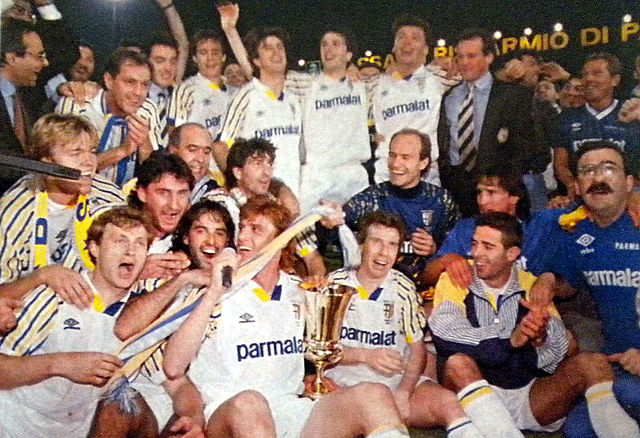
In that first season 1990-91, they signalled their intent with a stunning 2-0 victory over Juventus on their way to finishing 6th and qualifying for the UEFA Cup. Their first silverware followed a year later when they defeated Juventus 2-1 in the Coppa Italia final over two legs, securing their first ever major trophy while finishing 7th.
Another trophy was collected in 1992 when they defeated Royal Antwerp 3-1 in the UEFA Cup Winners Cup final. Parma added the first of their superstars to their ranks by bringing in the great Faustino Asprilla from Atletico Nacional and finishing 3rd. Lorenzo Minotti summed up the feeling at the club around this time when he said, “We never felt like a small club – Scala gave us belief”.
In the UEFA Super Cup that summer, they took on the Italian giants of Milan and beat them 2-1 on aggregate, before adding Gianfranco Zola to their ranks. They went on to another European final, the Cup Winners Cup again, losing to Arsenal 1-0 in a tight game.
They finally bagged the big prize in 1995, winning the UEFA Cup by defeating Juventus in the final AGAIN… Dino Baggio scored in both legs as Parma won 2-1 on aggregate, securing their highest honour yet. This was the peak of Scala’s era, with the likes of Zola, Asprilla, Baggio and Benarrivo firing Parma to the big prize and a 3rd place finish in Serie A.
The next season saw something of a transition season, as they finished trophyless and in 6th place, Scala would stand down at the end of the season and a certain Carlo Ancelotti would get his big chance to lead a Serie A team, being appointed from Regianna.

He immediately set about proving himself, by giving a young 17 year old goalkeeper his start in the game. I’m not sure whatever came of Gianluigi Buffon, but a quick Google confirms that Ancelotti made the right call. He also brought in a little known Argentinian striker for €4m from River Plate, Hernan Crespo would go on to be a huge success.

Parma finished second in Serie A that first season, just two points behind Juventus. Ancelotti was unable to repeat the feat next season and left after a 6th place finish and a UEFA Cup semi final defeat. His move to Juventus came that next summer and yet again, the Parma story involved a twist with Juventus.
Alberto Malesani was the man chosen to replace him and he oversaw perhaps the greatest triumph and squad that Parma ever had. Parma finished 4th in Seria A in 1998-99 and won the Coppa Italia, Supercoppa Italia and the UEFA Cup again, with a 3-0 win over Marseille. The team contained household names such as Gianluigi Buffon, Lilian Thuram, Fabio Cannavaro, Hernan Crespo, Enrico Chiesa and Juan Veron. It’s no wonder then that Cannavaro was quoted as saying, “That team could beat anyone on their day – we weren’t afraid of anyone”.
There’s no wonder when it looks like a Fantasy XI from early 00s Serie A!

The fall began soon after this. There was no league consistency, and despite another Coppa Italia triumph in 2001, Parma began to tail off. Crespo was sold to Lazio for around €56m, Buffon went to Juventus for a healthy €52m and Cannavaro moved to Inter. The exodus was swift and the reason soon became clear.
We’ll drift now from football to business, because in 2003 the Parmalat scandal broke. Europe’s Enron hit.
Calisto Tanzi had built Parmalat into a global dairy empire and used the money to buy Parma. To keep growing, Parmalat falsified accounts – inflating assets and hiding debts using offshore companies. By December 2003 a massive €14bn black hole had appeared and Europe’s biggest fraud case was confirmed.
Parmalat’s collapse triggered lawsuits and wiped out thousands of investors worldwide. Parmalat was the main source of income for Parma, they owned them and sponsored them. Overnight, funds dried up, transfers and wages were halted. Unlike the big northern clubs, there was no fallback money for Parma. Tanzi would be convicted and sentenced in 2008, but the damage for Parma was done.
In the words of Alberto Malesani, “Everything we had built vanished overnight”. The club would survive for around 10 years after this point, using loan signings and selling any promising talent and ownership would ping pong between small investors. Alessandro Lucarelli could have left at any point but didn’t, “I stayed because I’m a man of my word – Parma needed loyalty”.
Eventually, in 2015, Parma were declared bankrupt with debts of over €200m. The club was wound up and relegated to Serie D. Surely this was the end?
Not with Lucarelli around.
The club was reformed as Parma Calcio 1913 and the phoenix rose from the flames. Three consecutive promotions followed and by 2018/19, they were back at the top table with the big boys. It hasn’t been all plain sailing since then, they were relegated again in 2021 and struggled with money.
Kyle Krause took over at this point and stabilised the finances before a further promotion back to Serie A. Last season saw Parma struggle for a lot of the season before being saved after Christian Chivu took over. He’s gone now, but Parma have seen players and managers come and go before. They won’t be phased, in fact they’ll be buoyed by their spirit shown at the end of last season.
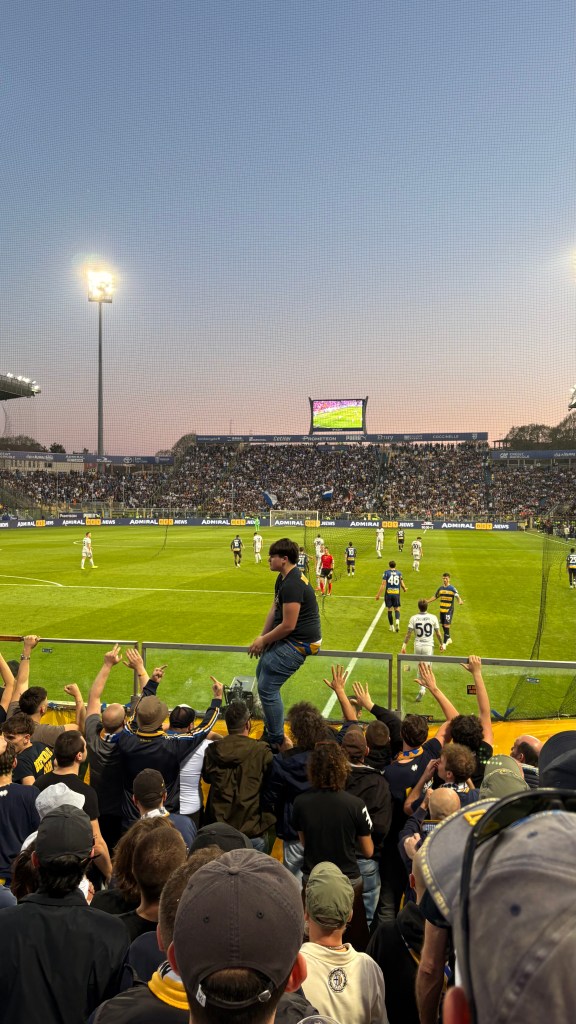
It wasn’t just Parma have struggled since the gilded age of Italian football came to an end. The influx of money into England from TV deals saw the balance of power swing from Italy to England in the early 00s. The best players decided to head to England instead of Italy, pragmatism was needed and the sugar daddies that once bankrolled the greatest league in the world moved on.
Stadium infrastructure in Italy lagged behind England, Germany and Spain too. Municipalities owned most of the stadiums and couldn’t afford to improve the facilities as the 90s drew to a close. Matchday revenues fell with the TV money. Scandals like Calciopoli followed and exposed systemic failures in Italian football governance.
Parma’s fall mirrored the fall of Serie A’s dominance in a way. Clubs can’t match the spending of England and Spain, Juventus modernised as a club, no one else has really followed suit.
Whatever happens in the future, Italy seems to have settled back into a rhythm. Clubs regularly make the latter stages of European competition again. Juventus and Inter both recently made 2 Champions League finals each, Atalanta won the Europa League, Inter lost a Europa League and Fiorentina played in two Conference League finals with Roma also winning one.
Parma are back at the top table, the glory days are gone, but talk to anyone from Parma and there’ll be a glint in their eye as they talk about Crespo and Chiesa scoring in the UEFA Cup final against Marseille…
 The Calcio Blog
Leave a comment